Warning, /swf-testbed/docs/e0-e1-interface-source-notes.md is written in an unsupported language. File is not indexed.
0001 # E0-E1 Interface — Source Notes
0002
0003 Extracts from the primary sources on the E0-E1 interface, for reference by
0004 the interface documents in this repository. Each extract cites its source;
0005 the sources are authoritative, these notes are the working digest.
0006
0007 ## Sources
0008
0009 - **Open questions discussion** — Echelon 0 - Echelon 1 Interface, Status
0010 and Open Questions, July 2026 Joint ePIC/EICUG Meeting (Landgraf,
0011 Battaglieri, Diefenthaler, Gunji):
0012 [Indico contribution](https://indico.bnl.gov/event/31808/contributions/126678/),
0013 [slides (PDF)](https://indico.bnl.gov/event/31808/contributions/126678/attachments/71377/122342/Diefenthaler-ePIC-E0-E1-Interface-20260715.pdf),
0014 [E0-E1 interface notes (running document)](https://docs.google.com/presentation/d/1hKGmzx91Q9FbFKKyMg_7TerNEVvY-8CxeAq6UINT1pc/).
0015 - **DAQ overview** — Introduction & Streaming DAQ: Overview, Requirements
0016 and Timeline, J. Landgraf, July 2026 workfest:
0017 [Indico contribution](https://indico.bnl.gov/event/31808/contributions/126677/),
0018 [slides (pptx)](https://indico.bnl.gov/event/31808/contributions/126677/attachments/71365/122332/SRO_Echelon0_Summary.pptx).
0019
0020 ## The interface open questions (July 2026)
0021
0022 Next step: formalize the E0-E1 interface in the Streaming Computing Model
0023 report, with detailed technical notes as needed. Target: September 2026.
0024
0025 Main open questions as presented:
0026
0027 - Raw-data and STF definitions and timeline
0028 - Evolution of the state model and transition rules
0029 - Latency requirements
0030 - Calibration and conditions databases
0031 - Information and control interfaces between E0 and E1
0032 - AI readiness and AI-enabled control
0033
0034 ## The DAQ run-control model
0035
0036 From the DAQ overview (Echelon 0 software design):
0037
0038 - The state model incorporates continuously running components (scalers
0039 are the example).
0040 - A "run" structure configures and selects the enabled detectors.
0041 - Slow-controls status is part of the state model.
0042
0043 This is the E0-side model the
0044 [E0-E1 state machine](e0-e1-state-machine.md) converges with.
0045
0046 ## E0-E1 interface concepts (DAQ side)
0047
0048 - Time frames are buffers of multiplexed whole-detector data covering
0049 ~0.6 ms; super time frames are ordered, contiguous sets of O(1000) time
0050 frames, roughly 0.6 s of detector data.
0051 - Likely independent DAQ systems, each with an independent STF stream:
0052 polarimetry (n × 1260 values, presented infrequently), luminosity
0053 detectors (n × 1260 values, each second), and the ePIC detector
0054 (100 Gbps).
0055 - On run start/stop, the DAQ notifies orchestration of detector/collider
0056 status via message; on STF production it writes the file to the buffer
0057 box and notifies orchestration of data availability via message.
0058 - Data banks: raw banks are produced by the readout, processing adds new
0059 banks without modifying existing ones, and a fraction of raw banks is
0060 always retained.
0061 - Echelon 0 scale: O(100) readout computers in the DAQ room and O(100)
0062 computers at the SDCC data center for time frame building, high-level
0063 filters, archiving, monitoring, logging, and QA.
0064
0065 The TF/STF picture in one view (figure maintained in the WFMS
0066 documentation, epic-wfms-docs):
0067
0068 [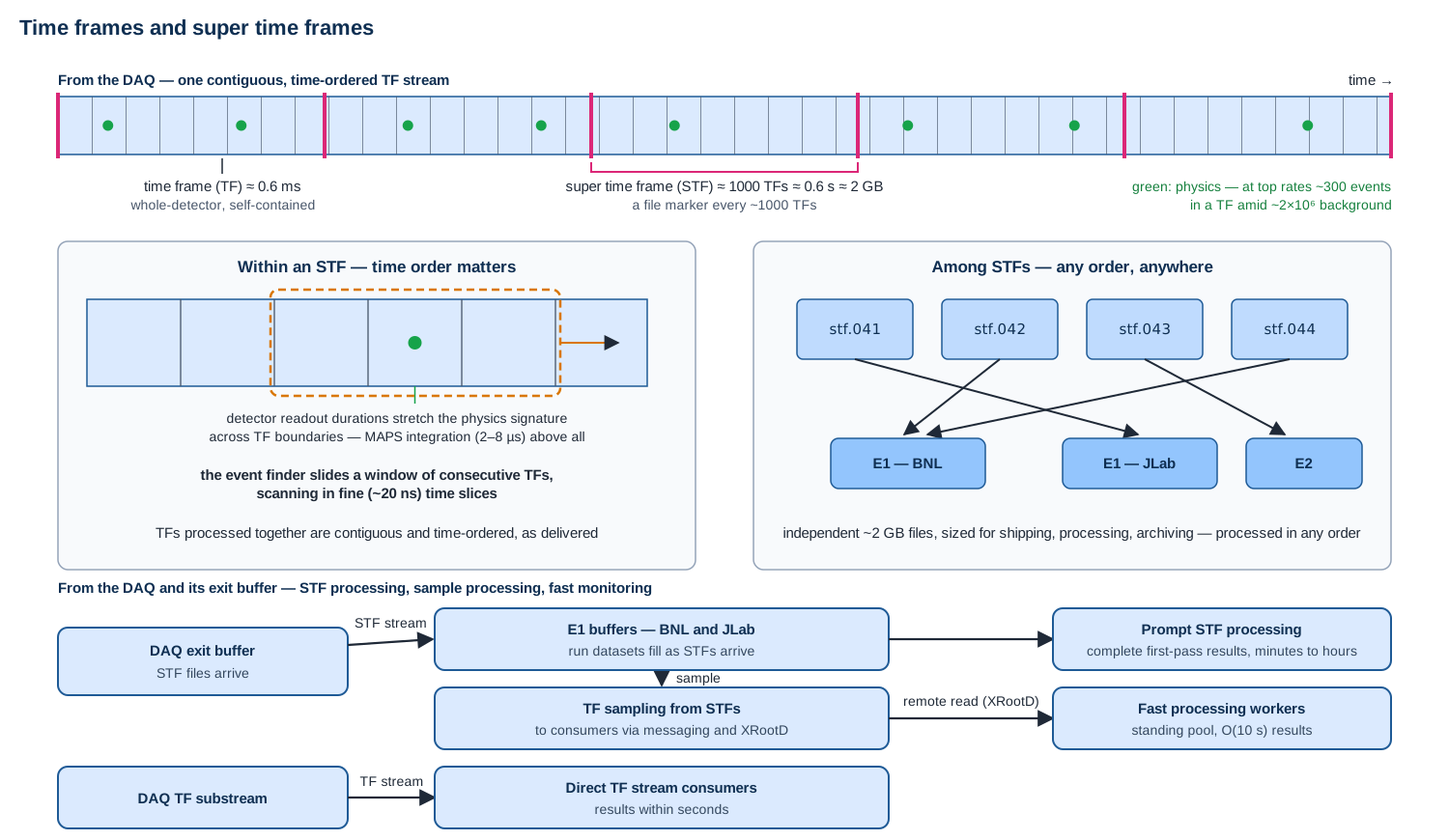](https://raw.githubusercontent.com/eic/epic-wfms-docs/main/docs/diagrams/tf_stf_explainer.svg)
0069
0070 ## Streaming reconstruction and event finding
0071
0072 From the streaming reconstruction talk
0073 ([T. Kumaoka et al.](https://indico.bnl.gov/event/31808/contributions/127067/))
0074 and the streaming readout AI background suppression talk
0075 ([D. Romanov et al.](https://indico.bnl.gov/event/31808/contributions/126682/)),
0076 July 2026 workfest:
0077
0078 - Vocabulary: simulation-side work organizes data in ~2 µs frames
0079 (Kumaoka's "time-frame (2 µs)", Romanov's 2000 ns frames) — the
0080 MAPS-integration sense of "time frame" noted in the DAQ overview,
0081 distinct from the 0.6 ms DAQ TF.
0082 - Triggerless readout means events are identified in software. Kumaoka:
0083 time splitting into ~20 ns slices; per-detector-set hit thresholds
0084 trigger candidate slices (pre-identification), then track/vertex-level
0085 event identification and ML classification in EICrecon. Scale at top
0086 rates: ~300 DIS events and ~2×10⁶ background events per TF.
0087 - Romanov: per-hit classification hits a ceiling — individual signal and
0088 background hits look identical — so window finding is the key step: a
0089 CNN + attention window finder locates the interaction burst in time,
0090 then in-window hit filtering. 99% signal retention, tracking up to 6.5×
0091 faster; integrated in EICrecon as an ONNX plugin and run on the 26.07.0
0092 campaign.
0093 - Common pattern: the event finder examines consecutive time intervals,
0094 and physics signatures extend across interval boundaries — MAPS
0095 integration (2–8 µs) above all — so the data processed together must be
0096 contiguous and time-ordered.
0097
0098 ## The DAQ AI-readiness plan
0099
0100 From the DAQ overview (AI requirements): AI is not a project requirement
0101 for the DAQ but is a potentially enormously useful tool for attaining the
0102 project requirements; the group is searching for concrete ways to make the
0103 electronics/DAQ "AI ready". The specific answers as of July 2026:
0104
0105 - Specific ML algorithms for specific features (e.g. dRICH dark current
0106 reduction in firmware).
0107 - MCP servers to make data accessible to LLMs: slow controls readout,
0108 EIC Controls readout (monthly discussions with EIC Controls), DAQ
0109 monitoring/logging, and run log database information.
0110 - MCP servers to provide APIs to allow LLMs (potentially) to control DAQ
0111 run control features.
0112 - The SRO WG orchestration testbed as the model.
0113
0114 These items, together with the deployed Echelon 1 MCP service
0115 (`swf-monitor/docs/MCP.md`), define the MCP-based AI backplane spanning
0116 machine, DAQ, and global computing. The backplane figure lives with the
0117 MCP service documentation in swf-monitor:
0118
0119 [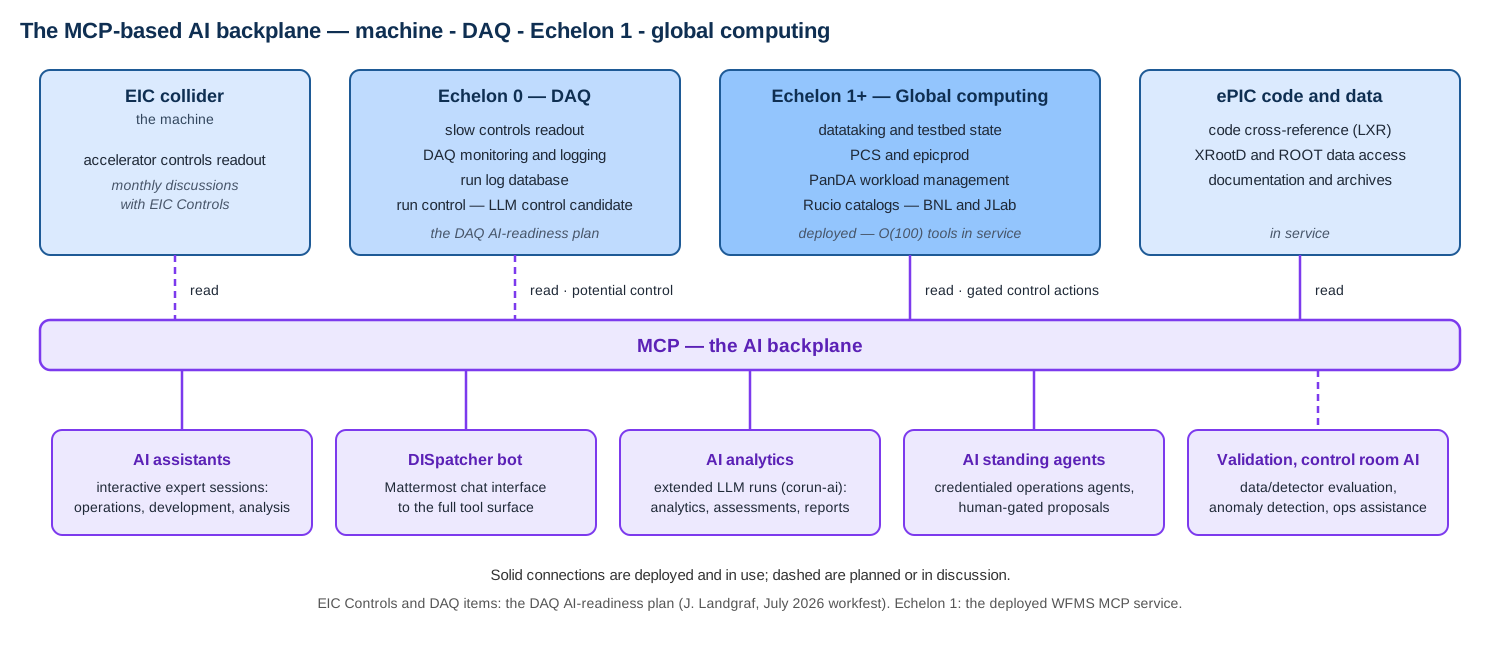](https://raw.githubusercontent.com/BNLNPPS/swf-monitor/main/docs/mcp-ai-backplane-v1.svg)


